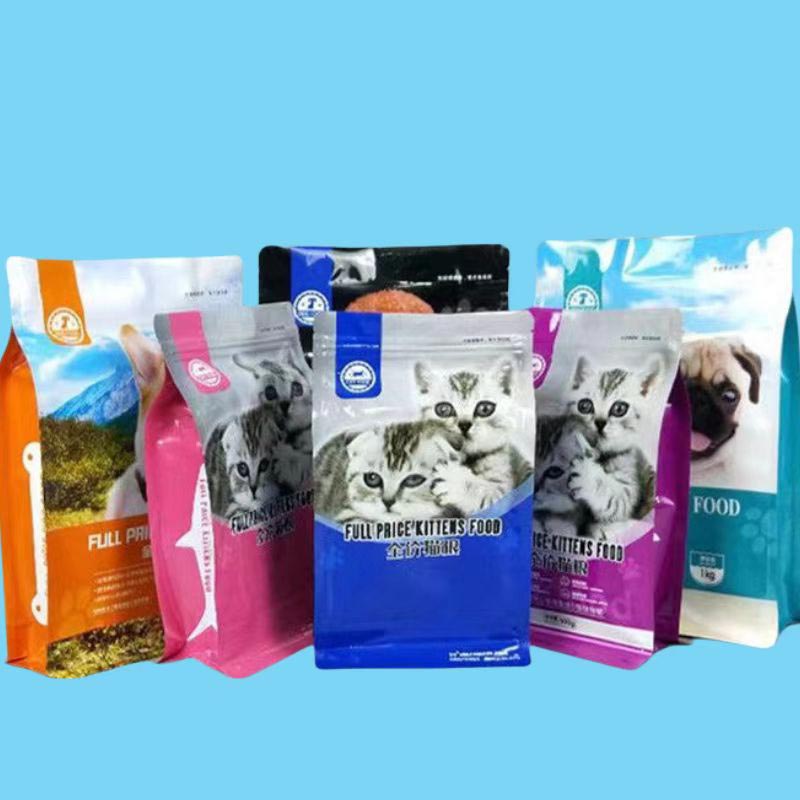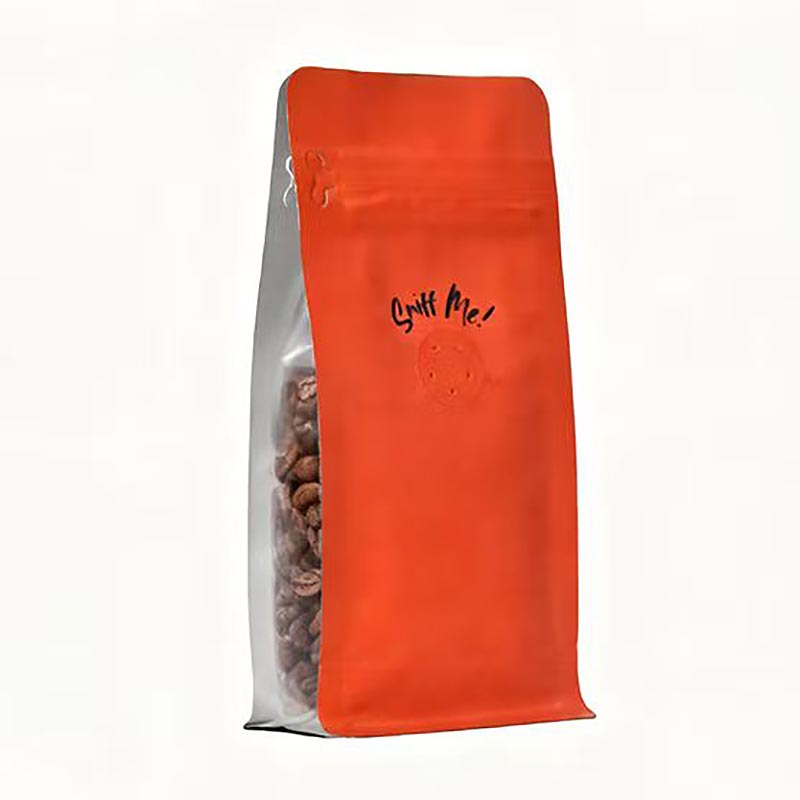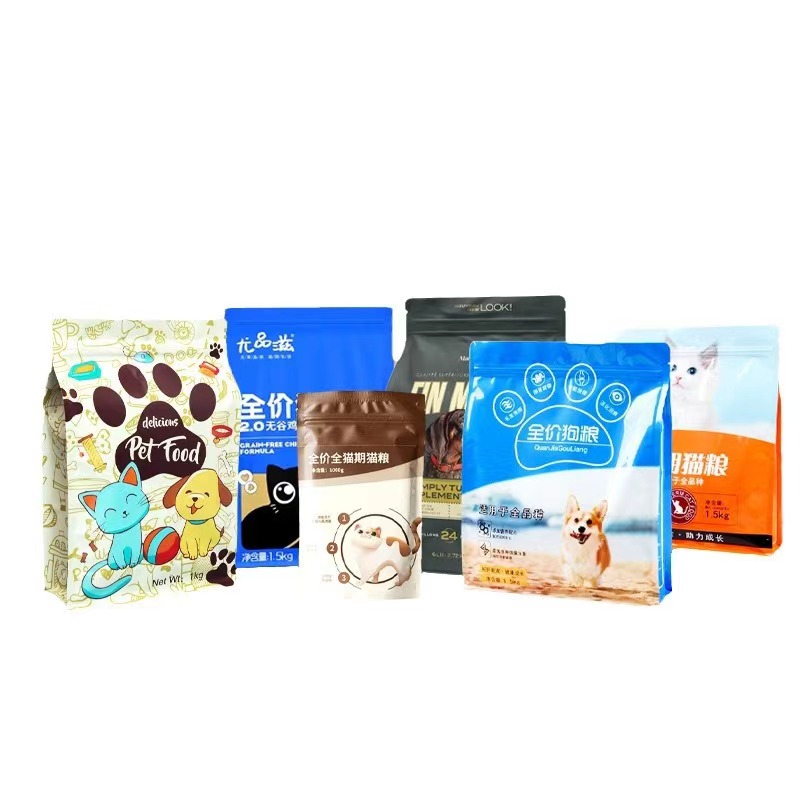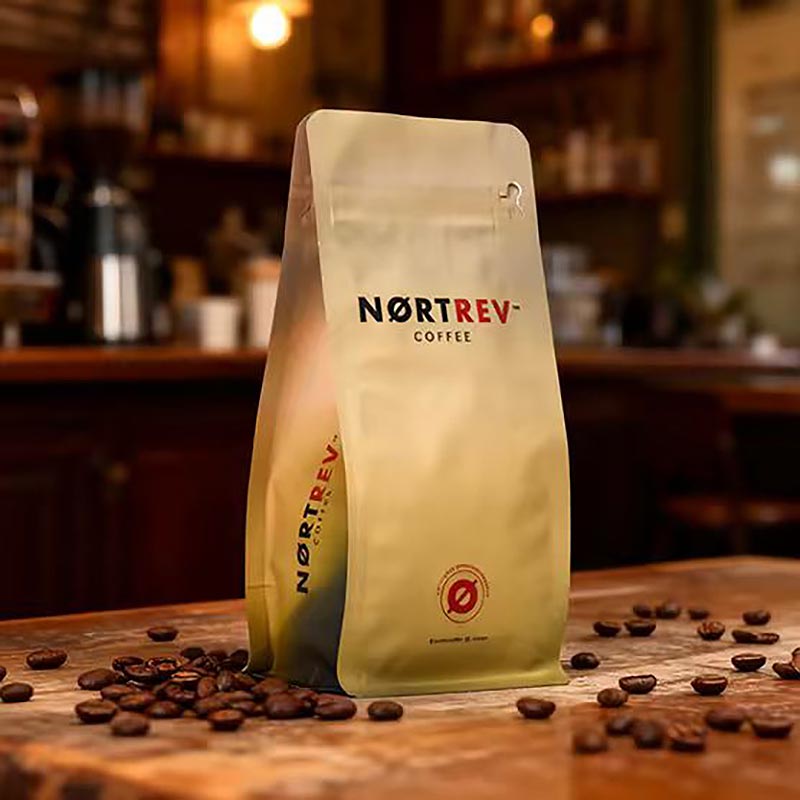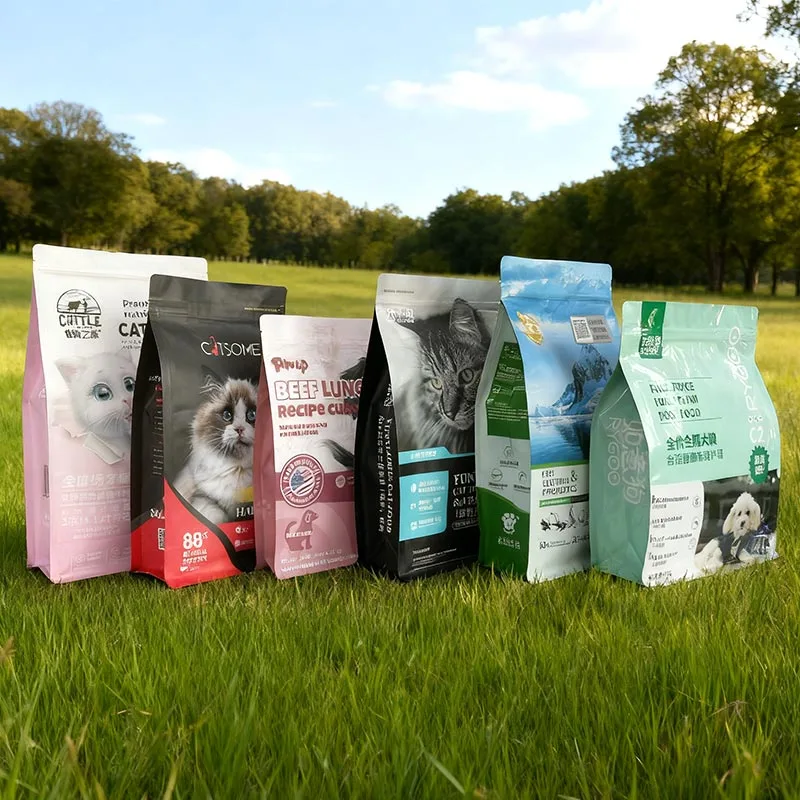
Pet food bags may look simple from the outside, but the material structure behind them is usually carefully designed around moisture, oxygen, grease, odor, sealing strength, and transportation conditions.
A bag for dry dog food does not necessarily need the same material structure as a bag for freeze-dried food or high-fat cat food. The right packaging material depends on the food formula, shelf-life target, bag size, filling weight, sealing method, and distribution environment.
In most flexible pet food bags, the main materials include PE, PET, BOPP/PP, PA (nylon), aluminum foil, metallized PET, EVOH, and kraft paper. These materials are often combined into multiple layers because each one performs a different job.
For example, PET may provide a strong printable outer surface, while PE provides heat sealing and flexibility. Aluminum foil or metallized PET can provide additional protection against light, oxygen, and moisture.
The main reason is simple: no single packaging material provides every property needed for most commercial pet food products.
A pet food bag may need to:
This is why laminated structures are common in pet food packaging.
A typical structure could be:
PET / PE
For products requiring a higher barrier:
PET / VMPET / PE
For products requiring very high barrier protection:
PET / AL / PE
PE (Polyethylene) is one of the most widely used materials in flexible pet food packaging.
It is particularly important because it can provide a reliable heat-sealing layer while remaining flexible and relatively resistant to moisture.
Common PE types used in packaging include LDPE, LLDPE, and different PE formulations designed for specific sealing and mechanical requirements.
PE can provide:
In a laminated bag, PE is often used as the inner layer, where it comes into direct contact with the pet food.
This layer is especially important for the integrity of the package. A bag can have excellent printing and barrier properties, but if the seal is weak, the packaging can still fail during filling, transportation, or storage.
For this reason, buyers should look beyond the name “PE” and ask about the specific PE grade, sealing temperature range, seal strength, and intended product-contact use.
PET (Polyethylene Terephthalate) is commonly used as the outer layer of laminated pet food bags.
It has good dimensional stability and provides a smooth surface for high-quality printing. This is particularly useful for brands that rely on detailed graphics, product photography, nutritional information, and strong shelf presentation.
PET can also contribute to:
A common structure is:
PET / PE
Here, PET mainly supports the outside of the package, while PE provides the sealing function.
However, PET by itself should not automatically be considered a complete barrier solution for every pet food application. The required oxygen and moisture barrier may need additional layers.
Polypropylene (PP), particularly BOPP (Biaxially Oriented Polypropylene), can also be used in flexible pet food packaging.
BOPP offers good stiffness, clarity, printability, and moisture resistance. It can be useful when packaging designers want a particular surface appearance or mechanical balance.
It may be found in:
PP-based materials can be attractive when cost, appearance, stiffness, and moisture resistance need to be balanced.
However, as with PE and PET, the suitability depends on the complete package structure rather than the material name alone.
PA (Polyamide), commonly called nylon, is useful when the package needs additional mechanical strength.
This becomes more important with larger bags or products that can put stress on the film during filling and transportation.
For example, large bags of dry dog food can be exposed to:
PA can improve puncture and tear resistance in suitable structures.
This does not mean every pet food bag needs nylon. For a small bag of soft treats, it may provide more performance than necessary. For heavy bags containing dense kibble, however, mechanical performance becomes much more important.
When a pet food product is particularly sensitive to oxygen, moisture, light, or aroma, aluminum foil can be used as a barrier layer.
A typical high-barrier structure is:
PET / AL / PE
| Layer | Main Function |
|---|---|
| PET | Printing, strength and surface protection |
| Aluminum foil | High barrier against light, oxygen and moisture |
| PE | Heat sealing and inner product-contact layer |
Aluminum foil is particularly useful for products where maintaining product quality over a long storage period is important.
It may be considered for:
The trade-off is that aluminum foil makes the package more complex and opaque. It is also not the same sustainability proposition as a mono-PE structure.
So the question should not simply be “Is aluminum foil better?”
The better question is:
“Does the product actually require the barrier performance provided by aluminum foil?”
If the answer is no, a simpler structure may be more economical.
VMPET, or metallized PET, consists of a thin aluminum layer deposited onto PET film.
It is often used when packaging requires stronger barrier properties than a standard PET/PE structure but does not necessarily require a full aluminum foil layer.
A common structure is:
PET / VMPET / PE
VMPET can help reduce the transmission of:
It also provides the familiar metallic appearance seen on many pet food packages.
For some products, this structure can offer a useful balance between packaging performance, appearance, and material cost.
However, VMPET should not automatically be treated as equivalent to aluminum foil. The actual barrier performance depends on the film specification, metallization quality, thickness, laminate structure, and converting process.
EVOH (Ethylene Vinyl Alcohol) is another material used when oxygen barrier performance is important.
Unlike aluminum foil, EVOH is a polymer barrier material. It can be incorporated into multilayer plastic structures, including structures designed around PE.
This is particularly relevant to the development of recyclable packaging.
Traditional pet food bags often combine several different material families to achieve strength, sealing, and barrier performance. Newer packaging designs increasingly attempt to achieve similar performance while simplifying the material structure.
That is one reason PE-based structures incorporating barrier technologies such as EVOH are receiving attention in the pet food packaging industry.
Kraft paper is popular because it gives packaging a natural, premium or environmentally oriented appearance.
It can also provide:
However, paper alone is usually not enough for demanding pet food applications.
Dry pet food can contain oils and fats, while moisture and oxygen can affect product quality. Therefore, kraft paper is often combined with plastic or barrier layers rather than being used as the only functional packaging material.
A paper-plastic laminate may look more sustainable, but its actual recyclability depends on the complete material structure and the recycling infrastructure available in the target market.
There is no universal “best” material for pet food bags.
Instead, different structures are used for different requirements.
| Material Structure | Typical Application | Main Advantage |
|---|---|---|
| PE / PE | Basic flexible packaging | Simple structure, sealing and flexibility |
| PET / PE | Dry pet food and treats | Printing, strength and sealing |
| BOPP / PE | Treats and flexible pouches | Appearance, stiffness and moisture resistance |
| PET / VMPET / PE | Higher-barrier pet food | Light and oxygen barrier |
| PET / AL / PE | High-barrier products | Strong protection from light, oxygen and moisture |
| PET / PA / PE | Heavy-duty bags | Improved mechanical and puncture resistance |
| PE-based mono-material | Recyclability-oriented packaging | Simplified polymer structure |
The final structure can also include coatings, adhesives, inks, closures, zippers, valves, handles and other components.
That is why evaluating only the film layers is not enough when purchasing finished pet food bags.
For ordinary dry dog food, the packaging does not necessarily need the highest possible barrier structure.
A typical dry kibble bag needs a combination of:
Moisture protection + grease resistance + adequate oxygen barrier + mechanical strength + reliable sealing.
For standard products, structures such as PET/PE or other PE-based constructions may be sufficient.
For premium or sensitive formulations, a higher-barrier structure such as PET/VMPET/PE or PET/AL/PE may be considered.
The correct choice depends on the formulation and shelf-life requirements rather than simply the product category “dog food.”
Freeze-dried pet food generally deserves more attention to barrier performance.
The product may be sensitive to:
Once moisture enters the package, the texture and quality of freeze-dried products can change quickly.
For this reason, high-barrier laminates can be appropriate for some freeze-dried products, particularly when a long shelf life is required.
Aluminum foil structures offer very strong barrier protection, while metallized and polymer-based barrier structures may provide alternatives depending on the required performance.
One of the important changes in pet food packaging is the development of mono-material packaging, particularly PE-based bags.
Traditional flexible packaging may combine PET, PE, aluminum, nylon and other materials because each provides a different function. The problem is that mixed-material structures can be difficult to recycle through conventional systems.
Mono-material packaging attempts to simplify this construction by keeping the main packaging components within one compatible polymer family.
PE-based mono-material pet food packaging is receiving particular attention because it can potentially combine:
However, there is an important point here:
Mono-material does not automatically mean “recyclable everywhere.”
Actual recyclability depends on the entire package, including films, coatings, inks, adhesives, zippers and local collection and recycling infrastructure.
If you are purchasing pet food bags for a brand, importing finished packaging, or developing a new pet food product, asking only “What material is the bag?” is not enough.
A better purchasing discussion should cover several points.
Dry kibble, freeze-dried food, treats, powdered supplements and high-fat products have different packaging requirements.
A 500 g pouch and a 15 kg dog food bag experience very different mechanical stresses.
Larger bags may need stronger puncture resistance, gusset performance, handles and seals.
A short local distribution cycle does not necessarily require the same barrier performance as a product intended for 18–24 months of international distribution.
If the formula contains sensitive fats, oils, vitamins or other oxygen-sensitive ingredients, oxygen transmission becomes an important specification.
For dry kibble and freeze-dried products, moisture protection can directly affect product quality.
If the target market or brand strategy requires recyclable packaging, discuss mono-material PE or other recyclable structures at the beginning of the project rather than trying to redesign the package after production.
The bag material needs to work with the customer's filling, sealing and packing equipment.
A theoretically excellent film is not a good packaging solution if it cannot run efficiently on the production line.
Another point that is often overlooked in pet food packaging purchasing is that the finished bag is a system of materials, not just one film.
For food-contact packaging, regulatory status can apply to individual substances and components within the packaging structure. Requirements may vary depending on the target market and the intended conditions of use.
For pet food sold in different countries, packaging suppliers should be able to provide appropriate documentation for the intended market rather than relying on a general statement such as “food grade.”
Depending on the project, buyers may need documentation concerning:
This becomes particularly important for brands exporting pet food to multiple markets.
The most expensive packaging material is not necessarily the best packaging material.
For example, using an aluminum foil laminate for every pet food product may provide excellent barrier protection, but it can increase material complexity and cost when the product does not require that level of protection.
On the other hand, choosing a very simple PE structure for a highly oxygen-sensitive product could create shelf-life and quality problems.
A better approach is to work backward from the product:
Product characteristics → shelf-life target → barrier requirement → mechanical requirement → bag format → material structure → production process → cost
This approach usually produces a more practical packaging solution than simply choosing a material based on what another brand is using.
The future of pet food packaging is unlikely to be about replacing every traditional bag with one universal material.
Instead, the industry is moving toward more application-specific structures.
High-barrier aluminum and metallized structures will continue to have a role where maximum protection is necessary. At the same time, mono-PE packaging is developing as brands look for packaging structures that can better fit recycling systems.
For buyers, this means material selection should start with the food itself, not with the packaging trend.
A good pet food bag should protect the product for the required shelf life, survive the distribution process, seal reliably on the production line, meet the target market's regulatory requirements, and achieve the required packaging cost.
In other words, the best pet food bag material is not the material with the most features. It is the structure that provides exactly the protection the product needs without adding unnecessary complexity.